
Why Sewers Back Up in Lakewood and Who Is Responsible
Two different problems can look the same at a basement floor drain. Knowing which one you have decides who has to fix it, and what to do next.
Two places a backup can start
Inside the property
A blockage in your own line or fixture: roots, grease, flushed wipes, or a damaged or collapsed pipe.
Outside the property
The public sewer is overloaded or blocked, so flow pushes back toward buildings.
The two can look identical at a floor drain. That's why diagnosis matters before deciding who has to fix it.
How Lakewood's sewers were built
According to the City of Lakewood, many of the city's sewers date to the early 1900s, and in many locations a single pipe carries wastewater and stormwater together, mixed in with two-pipe systems elsewhere. In dry weather everything goes to the city's wastewater treatment plant. When it rains or snow melts, excess flow can discharge to Lake Erie or the Rocky River.
Sanitary and storm sewers are also often in the same trench, one above the other, and the consent decree documents describe cross-connections between them.
Why heavy rain matters
The city says combined sewer overflows and basement flooding are related: basement flooding can occur when more flow than the sewers can handle arrives, or when a blockage keeps water from draining quickly enough. Lakewood publishes a combined sewer overflow status page with recent overflow activity.
That's why a backup that happens during or right after a storm is more likely to involve the public system than one that happens on a dry day.
What the city is doing
Clean Water Lakewood is the city's program to modernize its sewer infrastructure. In 2022 Lakewood entered a consent decree with the U.S. Department of Justice to bring its system into compliance with the Clean Water Act.
Federal documents describe required work including a high-rate treatment system, storage basins and pipe lining projects. The city also notes that its system serves part of the city of Rocky River, and that its sewers connect to Cleveland and Northeast Ohio Regional Sewer District sewers along its southern and eastern edges. Lakewood is not part of that district.
Who is responsible for what
According to the City of Lakewood, the city is responsible for repair and maintenance of sewer components in the public right-of-way, and the property owner is responsible for components on private property.
In practice, the public sewer main is the city's, and the private sewer lateral serving your building is the owner's. Where the line between them falls at your address is worth confirming with the city.
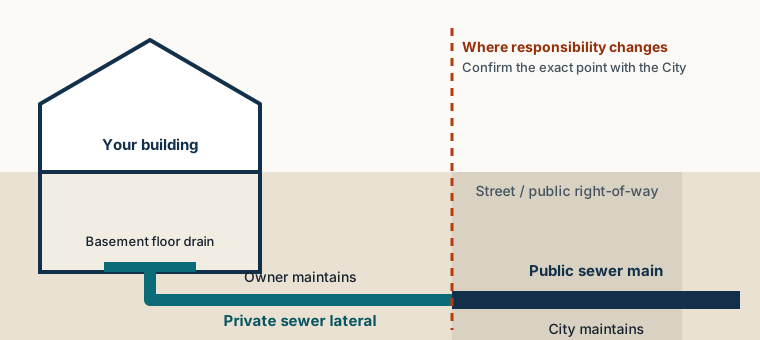
How to tell which side the problem is on
| What you see | More likely |
|---|---|
| Only your building affected, one drain slow for days | Your line |
| Neighbors also affected, or backup only in heavy rain | A system surcharge |
| Roots, grease or damage seen on camera | Your line |
| Water comes up in several fixtures during a storm | Public system involvement is possible |
A camera inspection is the reliable way to tell about your private line.
What to do after a backup
- Follow the first-hour guide.
- Get the space cleaned.
- Report the backup to the City of Lakewood through its website, and keep a record of what you report.
- Investigate the cause: drain cleaning, camera inspection or sewer line repair.
- Document for insurance.
What "combined sewer" does and doesn't mean for you
Living in a city with combined sewers doesn't mean your house will back up. Most of the time the system carries everything to the treatment plant without trouble. It means that during heavy rain there's less margin, and that a home with a low floor drain and an older line has fewer defenses when the margin runs out.
It also means that a backup that happens only during storms, especially one that neighbors report too, is worth telling the city about even if your own line turns out to be in good shape. The city can only see patterns that get reported.
Ways to reduce risk
- Keep wipes and grease out of drains.
- Deal with roots early, not after a backup.
- Keep your line in shape, and inspect it if backups recur.
- Consider a backwater valve where rain-related backups are a concern.
Reporting a backup to the city
Reporting is worth doing even when you've already called for cleanup. Give the address, the date and time, which fixtures were affected, whether it was raining, and whether neighbors had the same problem. Ask how the city tracks reports, and keep a note of the date you made yours. If the city later finds a problem in the main, or a pattern on your street, your report is part of that record.
City permits and requirements
Lakewood's Housing and Building department publishes requirements for certain water-control projects, such as sump and foundation-drain work. Check with the city before starting plumbing or drainage work, and see the service areas pages for how conditions differ across the city's districts.
Questions about your situation?
Call and describe what happened. We can tell you what a cleanup involves and point you to the right page.