
Backwater Valve Installation in Lakewood
A backwater valve is one of the few tools aimed at the public sewer pushing back into a building. It has real limits, and knowing them is part of deciding whether one makes sense.
What a backwater valve does
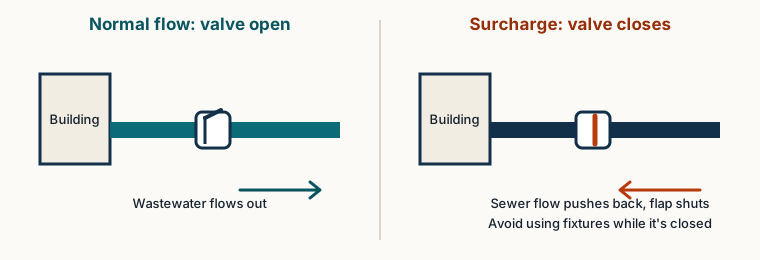
A backwater valve is installed on the sewer lateral. It lets wastewater flow out of the building normally and closes when flow tries to reverse, helping keep sewage from coming back in when the public sewer is overloaded.
Why it matters in Lakewood
The City of Lakewood describes parts of its system as combined sewers that carry wastewater and stormwater together, and notes that heavy rain can add more flow than the sewers can handle. The city also runs a combined sewer overflow status page. Where a surcharge pushes flow back toward buildings, a valve is one of the protective measures homeowners consider.
What it can't do
- It doesn't fix a blockage inside your own line.
- It doesn't stop stormwater entering through windows, window wells or other openings.
- While it's closed during a surcharge, your household water can't leave the building, so avoid using fixtures until flow returns to normal.
Placement and types
Valves can go indoors, often in the basement floor, or outside where access allows. The best location depends on the property: where the lateral leaves the building, how deep it is, what's above it and whether the valve will be reachable for maintenance. Types differ in how they operate, and some allow only one-way flow while others also let you close them by hand.
Incorrect placement can create new problems, including blocking flow in both directions, so where a valve goes matters as much as what it is.
Maintenance
A valve that's clogged or never checked can fail when it's needed. Follow the manufacturer's maintenance guidance and have it inspected. Debris and grease reduce reliability, and a valve you can't reach is one that doesn't get checked.
Permits
The City of Lakewood may require permits or inspection for plumbing work, so check with the city about what applies before installation.
Questions to ask before deciding
- Has water come up through a floor drain or basement toilet during heavy rain?
- Did neighbors have the same problem at the same time?
- Has a camera shown the lateral is in good shape?
- Is there a place to put the valve where it can be reached and cleaned?
Before installing one
A camera inspection can find problems in the lateral that a valve won't solve, and sewer line repair may need to come first. Otherwise you can end up with a valve protecting a line that's already failing. For cleanup after an existing backup, see the basement page.
Homes with large older basements
Homes with deep older basements, such as many in Clifton Park, have more to protect, so the case for a valve can be stronger. Whether it's right depends on the property and its backup history, not on the neighborhood alone.
Common questions
Will a backwater valve stop all basement flooding?
No. It addresses backflow through the sewer line only. Groundwater, window wells and foundation seepage are separate problems.
Do I need one?
It depends on your history of backups and how the property is set up. Read why sewers back up in Lakewood, and consider getting the line inspected first.
Can I use my plumbing during heavy rain if I have one?
Be cautious. If the valve closes during a surcharge, water you send down the drain has nowhere to go. Wait for the storm to ease when you can.
How do I know it still works?
By checking it on the schedule the manufacturer recommends. A valve that hasn't been opened and cleaned in years may be stuck.
Call about a backwater valve
Tell us about your backup history and where your sewer line leaves the house.